



Quilting with a Serger
Quilting with a Serger
Quilting with a Serger
April is BERNINA's Serger Month!
 I asked Andy Martin of @andymartinmakes to share his experience in using the BERNINA L890 (overlock/coverstitch combo). BERNINA has designated April as Serger Month and you can enjoy special pricing, 20% off serger feet and more! This month is a great opportunity for you to learn innovative ways to quilt, take your pieces to the next level, and change how you think about sergers.
Guest post by Andy Martin
Do you piece quilt tops on your domestic machine but have a serger sitting unused? You're not alone! I want to share with you how easily you can dial in a reliable quarter-inch seam on your serger / overlock machine and press beautifully flat joins. That 'intimidating' serger will feel like a powerful, precise quilting tool you've been underutilizing for far too long. The Straight Stitch (Stitch 16 – chainstitch) on the BERNINA L 890 lets you bring your existing piecing skills to serger speeds without sacrificing control.
 Why opt for the serger straight stitch when piecing?
The chainstitch on the L 890 closely resembles a traditional straight stitch, but it is created with a needle thread and a looper thread rather than a bobbin. This means a constant supply of thread and a sturdy, reliable stitch and is easy to undo if needed so no need to pull out your seam ripper. The chainstitch is a practical choice to support your quilting projects, making the process more straightforward and less frustrating, with beautiful clean seams.
Three main benefits to using chainstitch for piecing your quilts:
- Speed – Sew quickly at serger speeds, saving you time without sacrificing accuracy.
- The C28 Clear Cover/Chainstitch foot helps maintain a consistent quarter-inch seam allowance, keeping your seams precise.
- Pressability – Seams press smoothly to the side or open, resulting in a flatter, more polished quilt top.

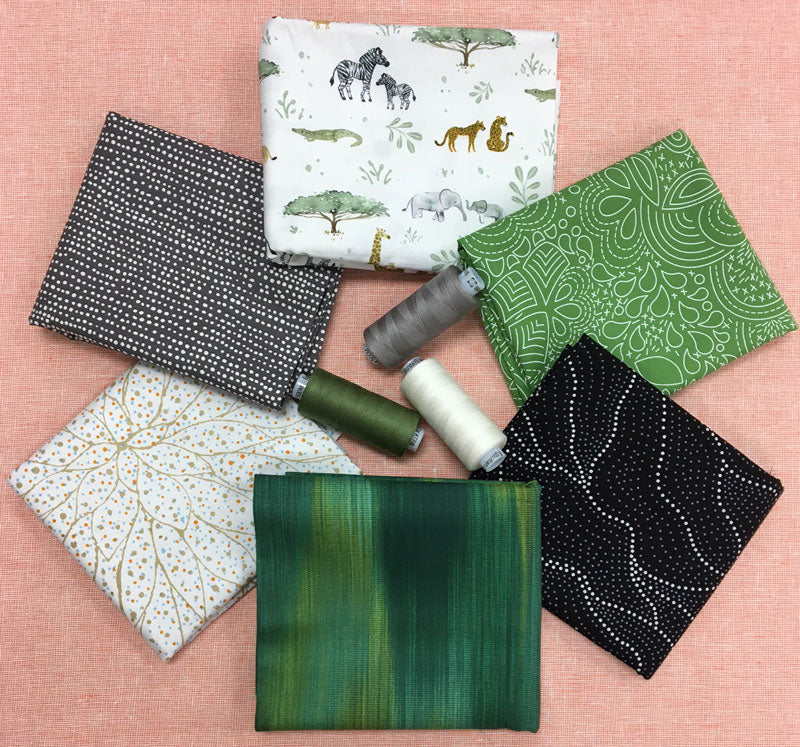
Read on to learn more, or visit the Artistic Artifacts YouTube Channel for my demonstration of Piecing Quilts Using the BERNINA L890 The quilt behind me during the video (detail shown above) is mine, pieced on my L890 — it's the Diana Quilt Pattern from the Stripology Quickies Book by Gundrun Ersla. Our fabric kit for the pattern includes the Seth Apter fabrics to make your own quilt top and binding. (Mark your calendar — Seth Apter will be returning to Artistic Artifacts this September to teach, and share information about his latest fabric lines!)
Using the Serger Straight Stitch

Getting started with chainstitch piecing on the L 890 is simple and designed to make you feel confident. It's part of the Cover Stitch group (#16) and doesn't use the knife, so edges stay untrimmed. Guided by clear on-screen prompts and the easy air-threading of the purple cover looper, setup is quick and stress-free.
To achieve perfect quarter-inch seams, align your fabric with the right edge of the C28 foot and set stitch length to 2.5. You can fine-tune stitch length, tension, and differential feed to suit a range of fabrics, from tightly woven quilting cottons to softer materials. With Total Stitch Control, you can customize every detail.
Once you're comfortable, the chainstitch can become a reliable powerhouse for your quilting. Sew entire quilt tops, units, and blocks continuously — no need to cut thread between segments. Just work one piece at a time, creating a seamless 'ladder' of patchwork that's easy to snip apart later.
This continuous sewing approach saves time, particularly on large projects or repetitive blocks. The longer presser foot and dual feed dogs help keep layers aligned at high speeds, so your long seams, like sashing or borders, come together quickly and neatly.
>
But wait, there's more! I use my L890, configured for a 3-Thread Overlock (Wide) and with Seracor 50wt Polyester thread in cones in the needle and upper looper and Iron & Fuse Thread by WonderFil Specialty Threads in the lower looper to attach the binding to my quilts. When I iron the binding to the back, the fusible thread adheres the binding to the back and I can finish my quilt with a quick stitch-in-the-ditch on my domestic machine. Pictured above, I demonstrated this technique at Artistic Artifacts earlier this year — my archived presentation is also saved to YouTube.
Achieving perfect quarter-inch seams consistently is simple with the C28 foot's markings and stitch plate guides. You can save your ideal settings in a user program for quick, stress-free access whenever you quilt.

Pressing seams open will greatly flatten your quilt top, especially for dense or intricate designs. It reduces bulk and helps your quilting lines travel smoothly over intersections. Of course, if you prefer traditional seams pressed to one side, the chainstitch can accommodate that too, offering you speed and flexibility.
Even with all its advantages, the serger is not always the right tool for every quilting task. For foundation paper piecing, where you're stitching directly on a printed line and often need ultra-precise control at very low speeds, a traditional sewing machine is usually the better choice.
Likewise, patterns with multiple points converging — like segmented hexagons or intricate star centers — can demand tight, incremental adjustments and careful pinning that are easier to manage with a standard ¼ in. piecing setup. In these situations, the serger's speed, longer foot, and feed system can make it harder to 'creep' into intersections or pivot exactly on a point, increasing the risk of blunting tips or shifting seams.
Think of the serger / overlock machine as your go-to for efficient, straight-line piecing and repeat units, like the flying geese quilt blocks I'm piecing in the photo above (watch my tutorial on YouTube). Reach for your sewing machine when foundation paper piecing or when your design calls for precise work at complex intersections.

As an experienced quilter, you know the difference that consistent seams, flat intersections, and efficient workflows make on a big project. When you finally put the L890's Serger Straight Stitch to work, your serger moves from 'mystery machine' to high-speed, dependable piecing partner.
If apprehension has kept your serger on the sidelines, consider this your nudge to plug it in, load Stitch #16, and let your quilting expertise — not fear — set the pace.
Judy here: Thank you, Andy — we learn so much from you! Andy is our go-to expert with all things serger and we appreciate his frequent contributions to our Facebook Live presentations each Saturday morning. Pictured above is one of his latest projects using leftover 2.5 in. strips — he pieced it on our floor model BERNINA L890 in the shop as part of our demonstrations of quilting techniques on March 21, National Quilting Day. The nine patch was strip pieced with three strips, then cut and pieced back together. He will use machine embroidery to embellish the negative space — we're looking forward to seeing it finished!



Leave a comment